ABOUT DIA


Oceanside Día de los Muertos – the Mexican “Day of the Dead” -
is a festive holiday with a complex history and fusion of old traditions.
Oceanside has been celebrating with a festival for 25 years.
Guests can see the Ofrendas – altars to loved ones - Downtown, in the past in the inner Mission gardens, and for over a decade in the Car Show, and enjoy music, dancing, samplings of traditional foods and entertainment.
Bring the whole family for a new cultural experience.
ALTARS
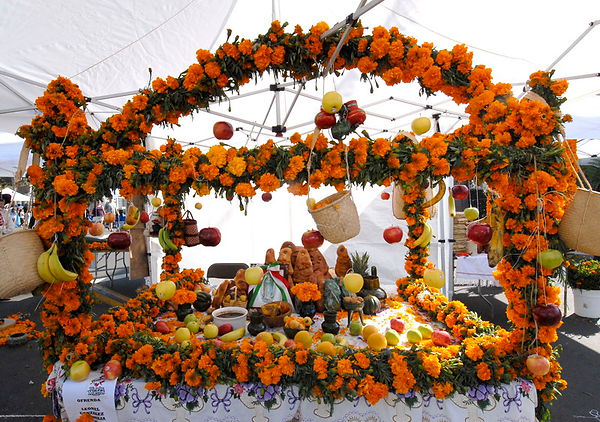
The altars, full of “ofrendas,” are the focal point on Día de los Muertos. In Mexico they are built at home and/or at the grave site. Entire families construct altars annually. These altars have four levels and four sides. They represent the four stages of life, the four points of the earth, the four seasons and the four cardinal points upon which the pyramids were built.
Based on this concept, the following items are used at Dia de los Muertos:
The four principal seeds of the Mexicas - tomatillo (green tomato), cacao, chile and corn
The symbols of the four elements of life – water, fire (candles), earth (seeds), and wind (flags, flutes and conch shells)
The four stages of life and the elements are also represented through corn, the main staple of Mesoamerica for thousands of years, including tortillas, tamales, pozole, atole, totopos, and esquites, among many other items.

THE TRADITION
The Festival of Dia de los Muertos celebrates the lives of the dead, the interaction between the living and the dead and the cycle of life.
This view of death started with Mesoamerican cultures more than 3,000 years ago. From Mexico to Nicaragua, societies believed that at this time of year the boundaries separating the living and the dead weakened, and the deceased could visit the living. Unlike the Spaniards who viewed death as an end, they saw it is as a continuation of life. Instead of fearing death, they embraced it. Life was a dream and only in death did they become truly awake.
Traditionally celebrated on November 1st and 2nd, the holiday varies from region to region and also by degree of urbanization. In small towns of Mexico a candlelight procession to a cemetery is held by most families on the eve of the celebration. Family members decorate gravesites with flowers and enjoy a meal. Offerings are brought to dead loved ones and include their favorite foods, beverages, toys and personal belongings. Family members may also spend the night and share the memory of their loved ones by telling stories about them.
TODAY
Many Mexican immigrants, especially those from the Oaxacan region, bring these traditions and now share them in Día de los Muertos Festivals throughout the United States. The commemoration is not mournful but rather a time to share with family and friends. Some people attend because they are curious, and others just want to have a good time.
TERMS
Angelitos – souls of the children who have died, literally “little angels”
Atole – an ancient drink made from corn meal and water flavored with various fruits
Calavera – a skull tat symbolizing death, or a slang for daredevil. Also satirical songs/poems
Mascara or Careta – a face mask
Cempasúchitl – yellow marigold, symbol of death
Mole – a sauce made from chilis, sesame seeds, herbs, spices, chocolate and fruit
Ofrenda – “offering,” refers to the goods set out on the altars
Copal (incense) – the smoke represents the soul leaving the material body. Some believe copal mixed with the smell of cempasúchitl resembles the smell of bones and death.
Pan de Muerto – bread of the dead, with a hidden figurine in the center
What is the difference between Halloween and Day of the Dead?
Halloween, or All Hallows’ Eve, celebrated on October 31, is based on ancient Celtic lore that also believed the boundary between the living and the dead dissolved at this time of year. The Celts thought, however, that the dead could become dangerous and threatening, and so the holiday is populated by demons, witches, and other images of terror. Scary costumes were worn in an attempt to placate evil spirits.

